Territory planning and territorial protection in a franchise system
How large should a territory be, what may the franchisor protect, and how do you handle online orders? A guide to fair and clear territory planning.
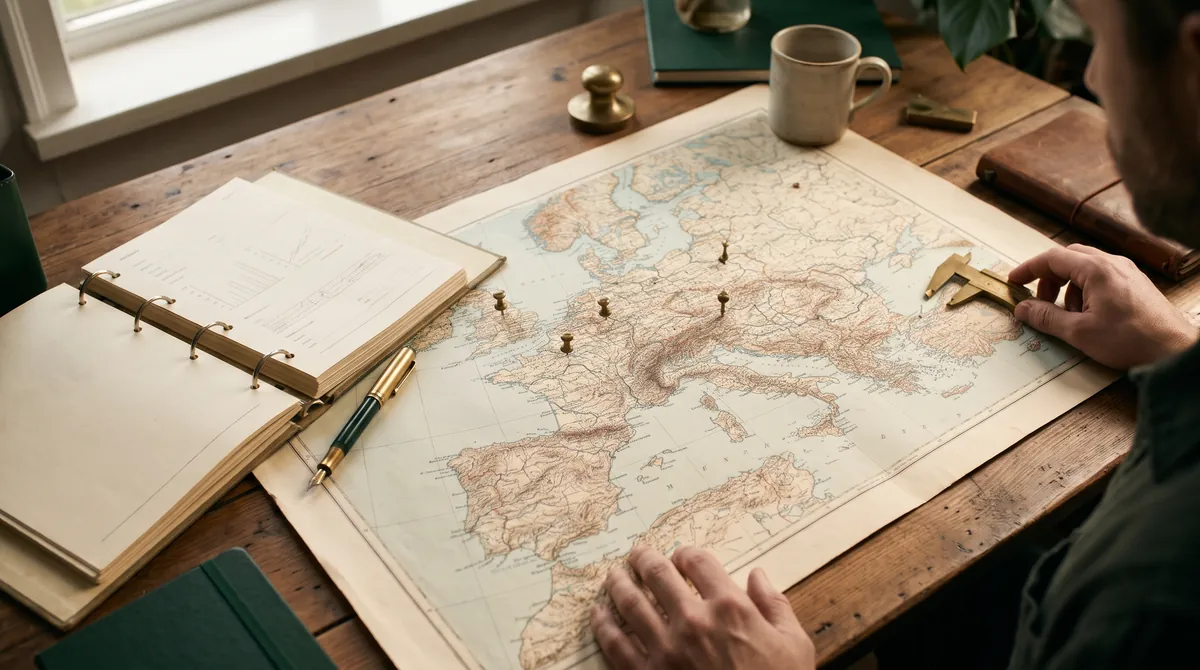

A large map lies on the meeting table at head office. Some towns are already marked in colour, others carry a question mark, and for one region there are two candidates at once. Where does one franchisee’s territory end and the other’s begin, and what happens when someone from the neighbouring town orders online? Territory planning sounds like administration, but it is one of a franchisor’s most important strategic tasks. Clear territories give franchisees security, prevent conflicts and make the network predictable.
Four territory models at a glance
Franchise systems work with different models, depending on the sector and the concept. Which one fits depends on how many customers an outlet needs, how far customers will travel for the service and how quickly the network is meant to grow.
| Model | What it means | Points to consider |
|---|---|---|
| Exclusive territory | The system opens no further outlet within the defined territory | The territory must be large enough to be viable and small enough to be worked properly |
| Location protection | Only a radius around the outlet is protected | Further outlets of the same system in the same town remain possible |
| Open territory | No protection, several outlets in the same area are possible | Franchisees need a great deal of trust in head office’s network planning |
| Development territory | A multi-unit franchisee opens up a larger territory according to a fixed opening schedule | The schedule must suit the franchisee’s capital, staff and market |
The development territory model is also known as area development: a franchisee undertakes to open several outlets in a larger territory according to an agreed timetable. If they fail to keep to the schedule, agreements often provide that the territory is reduced or that protection lapses for the parts not yet developed. The model suits experienced business owners who bring capital and a management layer of their own.
How large a territory should be
A territory has to be large enough for a franchisee to do good business there, and small enough that they actually work all of it. A territory that is too large remains partly undeveloped, and customers drift away to competitors. One that is too small leaves the franchisee little room to grow. It has proved useful to determine the size on the basis of several criteria:
- Population and demographic structure in the catchment area
- Size and composition of the target group
- Purchasing power in the region
- Accessibility by car, by public transport or on foot
- Competition from other providers
- Potential for the franchisee, including for a later second location
- Planning of the whole network, so that neighbouring territories fit together sensibly
Data on population and purchasing power are available from sources such as statistical offices, local authorities or the chambers of commerce and industry (IHK). What matters is that you apply the same method to every territory. Territories then become comparable, and franchisees understand why theirs is drawn the way it is. Territories can also be designed in stages: a core territory for the first outlet and an option on an adjacent territory once the franchisee reaches agreed targets. That way the protection grows as the business develops.
What competition law allows
Territorial protection touches on competition law, because it limits where and to whom franchisees sell. In the European Union, the decisive rules are set out in the Vertical Block Exemption Regulation (EU) 2022/720. It exempts certain agreements between companies at different levels of the supply chain from the ban on anticompetitive agreements, provided the market share of each party does not exceed 30 percent. Three points matter most for territorial protection:
- Active sales: The franchisor may prohibit franchisees from specifically targeting customers in a territory that has been allocated exclusively.
- Passive sales: If a customer makes an enquiry of their own accord, the franchisee may in principle serve them, even if the customer comes from another territory.
- Online sales: A general ban on selling online is not permitted. Quality requirements for the online presence, on the other hand, are possible.
Active sales include, for example, targeted approaches by letter, e-mail or phone, and online campaigns aimed at a particular territory. Passive sales occur when customers come of their own accord, for instance via the publicly accessible website. Drawing the line in an individual case is demanding. So have your territorial clauses reviewed by a specialist lawyer experienced in competition and franchise law. Since rules and interpretative guidance can change, it is worth checking the current position regularly.
Clear territorial boundaries protect not only the individual franchisee but also the peace across the whole network.
Practical questions to settle in advance
Many conflicts arise not in the agreement but in day-to-day business. So decide early on how you will handle typical borderline cases:
- Delivery services and online orders: Which outlet delivers when an order comes in from across a territorial boundary, and how is the revenue allocated?
- Corporate customers with several sites: Who looks after a company that has branches in several territories? Head office often takes on such framework agreements and distributes the work among the local franchisees.
- Trade fairs and events: May a franchisee exhibit at a trade fair in a neighbouring territory, and how are the contacts made there shared out?
Territorial boundaries are best described unambiguously, for example by postcodes and a map attached to the agreement. Wording such as “the greater area” or “the surrounding area” leads to misunderstandings sooner or later, especially when towns grow or new residential areas appear. Record the rules for borderline cases in writing as well, for example in the manual or in an annex to the agreement, and explain them to new franchisees during the selection phase. Anyone who knows the rules of the game before the first borderline case arises reacts more calmly.
Special features in Spain and on the islands
If you are planning territories in Spain, for example on Mallorca or the Costa del Sol, you will face questions of your own. Tourist resorts are much busier in summer than in winter, and some businesses live mainly off the season. Population figures alone say little there. Alongside the local population, holidaymakers and residents also count, meaning people from abroad who live there permanently or for a large part of the year. On islands, geography sets limits too: a territory ends at the coast, and journeys between towns often take longer than the map suggests. Here it can make sense to plan territories by season and target group rather than by population alone. The article on expanding into Spain covers this in more detail.
Territory planning as part of the search for franchisees
A well-thought-out territory plan is also a tool for finding franchisees. If you know which regions you want to open up next, you can announce specifically where you are looking for franchisees. Candidates see immediately whether their preferred region is available, and head office concentrates its efforts on the territories that will strengthen the network most. Keep the plan up to date and tell your franchisees how the network is meant to develop. Those who know what is planned for the neighbouring territories can prepare for it and feel part of the whole.
Frequently asked questions
May a franchisor prohibit online orders from other territories?
A general ban on online sales is not permitted under the Vertical Block Exemption Regulation. If a customer orders of their own accord, this is usually a passive sale, which the franchisee may in principle fulfil. Quality requirements for the online presence, on the other hand, are possible.
What is the difference between an exclusive territory and location protection?
In an exclusive territory, the system opens no further outlet. With location protection, only a radius around your own outlet is protected. Outside that radius, further outlets of the same system are possible, even in the same town.
What happens if a multi-unit franchisee does not keep to the opening schedule?
The agreement governs this. It often provides that the territory is reduced or that protection lapses for the parts not yet developed. Such consequences should be described clearly and fairly from the outset.
Does territorial protection also apply to corporate customers with several sites?
That depends on what the agreement says. Head office often looks after such customers through framework agreements and distributes the work among the local franchisees. What matters is that the rule is in place before the first case arises.
This article is for general information and is not legal, tax or financial advice. Laws and funding programmes can change; discuss your own situation with a specialist lawyer, tax adviser or your bank.
Read on in our network
- maidavBusiness, finance, future
Background on business management, finance and the questions shaping the future of small and medium-sized companies.
- MiliniaMoney and markets
Reporting on money and markets, with analysis that helps when assessing regions and sectors.