Doing business on Mallorca and the Costa del Sol: market, season, partners
Two regions with a large German-speaking community: where the opportunities lie, how the season shapes the business and what steps setting up a company in Spain involves.
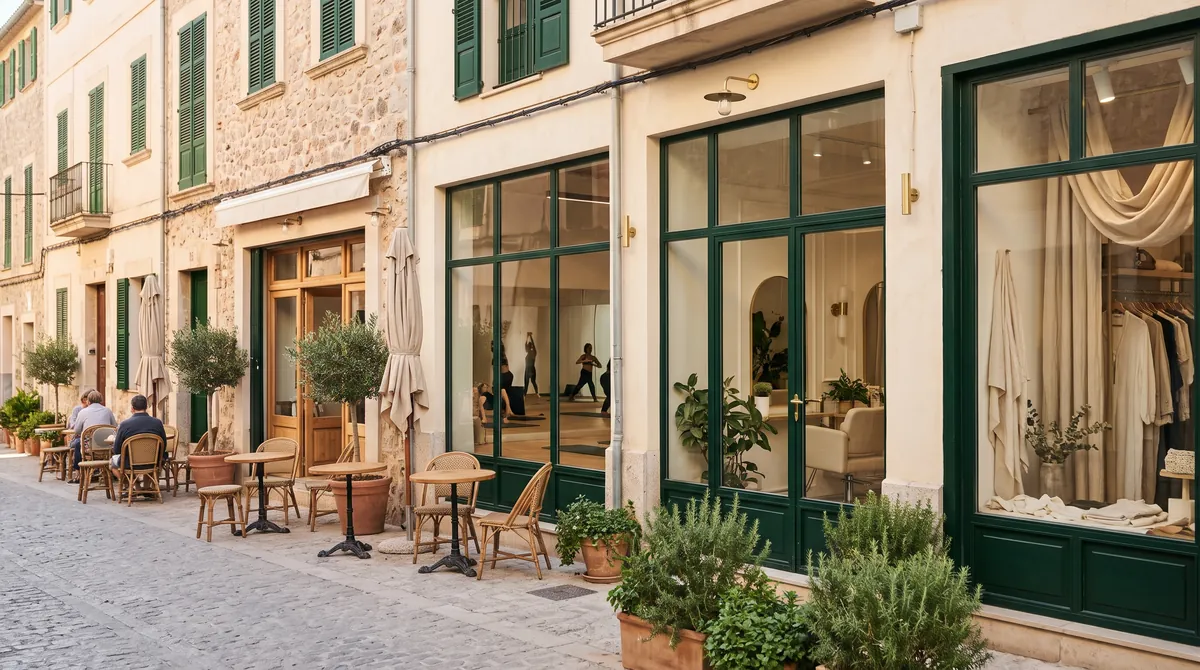

The coffee on the terrace is still warm when the phone rings: a neighbour has recommended the business, and a new customer would like an appointment. On Mallorca and the Costa del Sol, a lot of work comes in exactly this way, through a conversation, a tip, a name someone passes on. Both regions have a large international and German-speaking community of residents, second-home owners and holidaymakers. For business owners this means opportunities, but also rules of its own. If you set up a business there or introduce a franchise concept, you should understand the market, the season and the administration.
Two regions, two frameworks
Mallorca belongs to the Balearic Islands, an autonomous community with its own regional government. The island is divided into municipalities, among them the capital, Palma. The Costa del Sol lies in the province of Málaga and belongs to Andalusia. For business owners this structure has practical significance, because responsibilities are shared between the state, the region and the municipality. What applies in Palma need not be regulated in the same way in a municipality on the Costa del Sol.
The language differs too. Spanish is the official language everywhere, and on Mallorca Catalan is a second official language. Official letters, forms and signs there may be bilingual or entirely in Catalan. If you speak Spanish, you will get by well in both regions. On Mallorca, a basic knowledge of Catalan is a friendly gesture that opens doors.
Where the opportunities lie
The international community has needs that are spread across the whole year. Houses and flats need looking after, and people want to stay healthy, feel good and make the most of their free time. This gives rise to several lines of business:
- Services for residents: trades, property management, health, beauty and fitness, ideally in their own language
- Tourism and leisure: tours, classes, rentals and experiences for holidaymakers
- Food service: from the café in the village to the restaurant with a terrace
- Property-related services: looking after second homes while the owners are away, cleaning, gardening and maintenance
Many of these services can be built up as a franchise; others start as an independent business or as a partnership between several business owners. People from Germany, Austria or Switzerland often bring with them the language, working style and expectations that precisely this clientele values. At the same time, it pays to look beyond your own community: Spanish and international customers appreciate reliable businesses just as much.
The season sets the pace
In both regions, the high season is summer. That is when the holidaymakers are there, second homes are occupied and terraces are full. Mallorca is generally regarded as more seasonal, while on the Costa del Sol more businesses operate all year round. This is a tendency, not a fixed rule, and it depends heavily on the location and the sector.
For your planning, this means that staffing and liquidity must also carry the quiet months. If you earn well in summer, build up reserves for the winter. Seasonal staff are recruited early, because in the high season everyone is looking at the same time. Year-round customers, residents above all, even out the fluctuations. A business that appeals to both groups stands on two legs.
What a franchise concept should offer there
If you want to start out as a franchisee on Mallorca or the Costa del Sol, look at the system with a particular eye. A concept that works well in a German city centre often needs adapting for a tourist region. Helpful signs are the head office’s experience with seasonal markets, documents and training in Spanish, templates that fit Spanish formalities, and marketing that appeals to residents and holidaymakers alike. Ask, too, whether there are already franchisees in the region you can talk to, and how the territory is defined if customers come from several towns. A separate article on expansion and the legal framework describes how franchisors themselves plan their move into Spain.
Setting up in Spain: the essentials
The steps involved in starting a business in Spain follow a logic of their own. The following overview shows the essentials and is no substitute for advice:
- Apply for an NIE: the NIE (Número de Identidad de Extranjero) is the tax identification number for foreigners. It is needed for almost every further step.
- Choose a legal form: as a self-employed person you work as an autónomo (sole trader) and are insured in the special social security scheme for the self-employed, the RETA. Alternatively, you set up a Sociedad Limitada (S.L., a private limited company), which is entered in the Registro Mercantil (the commercial register).
- Register for tax: the activity is registered with the Agencia Tributaria (the national tax agency), while social security is handled by the Seguridad Social.
- Obtain the municipal licence: for business premises, the business usually needs an activity licence, the licencia de actividad, from the Ayuntamiento (the town hall).
- Arrange support: it is customary to work with a Gestoría (an administrative agency for tax, social security and official procedures), which handles applications, registrations and ongoing returns.
Which legal form suits you depends on liability, the scale of the business, the number of shareholders and tax considerations. The following comparison shows the essentials:
| Feature | autónomo | Sociedad Limitada (S.L.) |
|---|---|---|
| Form | Sole trader | Limited company, comparable to a German GmbH |
| Registration | Agencia Tributaria and Seguridad Social under the RETA | Incorporation with entry in the Registro Mercantil, then the Agencia Tributaria |
| Liability | Personal, with your own assets | In principle limited to the company’s assets |
| Suitable for | Individual self-employed people and a simple start | Businesses with several shareholders, staff or a larger scale |
A simplified overview. The decision in each case is one for a Gestoría or a local tax adviser.
For franchisees there is one more question: some franchisors set requirements on the legal form or recommend a particular solution. Clarify this early, because it affects contracts, talks with the bank and leases.
Network and recommendations
In both regions, personal networks play a particularly important role. A lot of work comes through contacts: the property manager recommends the electrician, the restaurant the boat hire, the neighbour her beautician. Newcomers look for people they can trust and ask their circle of acquaintances first. If you do good work, are reliable and give recommendations yourself, you will grow through this network.
Here, a lot of work comes through people who know and trust each other.
This is also where royaltry comes in: the magazine is starting out with personal recommendations from business owners on Mallorca and the Costa del Sol. They bring to light experiences of working together that would otherwise only be passed on in conversation. For your own business, it pays to cultivate your network deliberately: contacts with businesses whose services complement your own offer, regular meetings with other business owners, a presence at local events. Our article on recommendation networks describes in more detail how such a network is built and maintained.
Bringing in local experts
Spanish law, regional regulations and municipal licences differ from the German framework, and rules can change. That is why good support belongs from the very start: a Gestoría for administration and registrations, a tax adviser who knows both countries if you still have ties to Germany, and a local law firm for contracts. These experts do not replace your own planning, but they prevent a good start from getting stuck on formalities. You can recognise good support by the way it explains procedures clearly, keeps an eye on deadlines and tells you in good time which documents are missing.
Frequently asked questions
Do you need an NIE to set up a business in Spain?
Yes. The NIE is the tax identification number for foreigners and is needed to register with the tax agency and social security. Apply for it early, because many further steps build on it.
Should you start as an autónomo or set up a Sociedad Limitada?
That depends on liability, scale, the number of shareholders and tax considerations. Starting as an autónomo is simpler, but you are personally liable. A Gestoría or a local tax adviser will help you decide.
Is German enough as a business language?
Often it is for German-speaking customers, but not for the authorities, contracts and staff. Spanish is the official language everywhere, with Catalan as an additional one on Mallorca. Good Spanish makes everyday life considerably easier.
How can you bridge the quiet period outside the season?
With reserves from the high season, year-round customers among the residents and offers that suit the quieter time. Plan staffing and liquidity for the whole year, not just for the summer.
This article is for general information and is not legal, tax or financial advice. Laws and funding programmes can change; discuss your own situation with a specialist lawyer, tax adviser or your bank.
Read on in our network
- island mallorcaThe island atlas
The island atlas of Mallorca, with articles on places, lifestyle and life on the island.
- Costa del SolCoast and lifestyle
Coast and lifestyle on the Costa del Sol.